
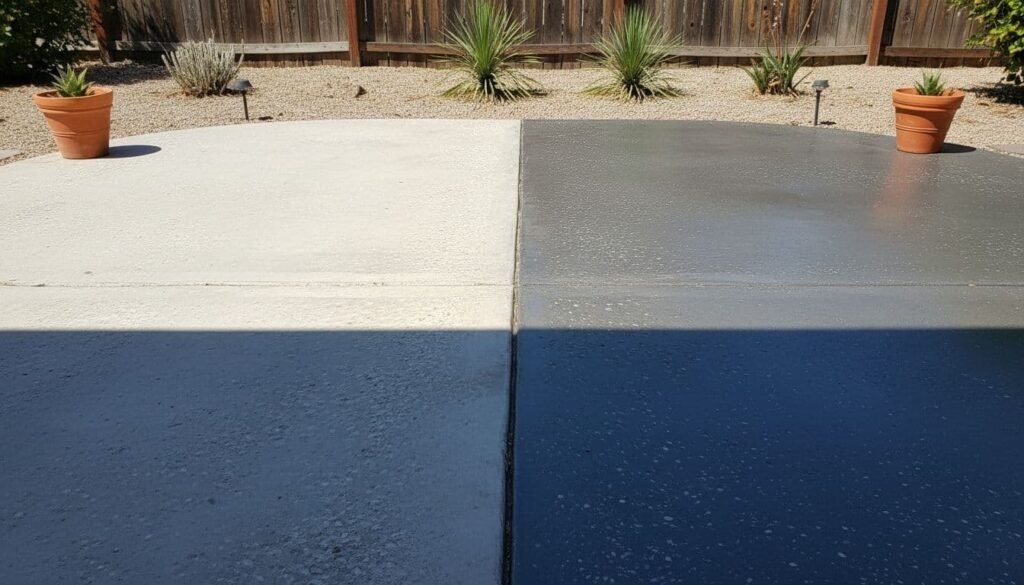
If your patio looks dusty, faded, or always seems to stain, Bakersfield’s weather is a big reason. Our summers bake concrete, the air stays dry, and the sun pounds the surface day after day.
Done right, concrete patio sealing keeps stains out, slows color fade, and makes routine cleaning easier. Done wrong, it can peel, turn cloudy, or show roller marks that never go away. This guide walks you through what works in the Central Valley heat and what to avoid.
Why Bakersfield heat is hard on unsealed concrete
Concrete is tough, but it’s also porous. In Bakersfield, the problems pile up fast:
- Intense UV breaks down many sealers and fades decorative color.
- Low humidity speeds evaporation, so sealers can flash-dry before they level out.
- Dusty winds drop grit onto wet sealer, leaving a rough, dirty finish.
- Hot slabs can cause bubbles and lap lines, even when the air feels “fine.”
Sealing is protection, but it’s also timing and prep. Most failures I see come from sealing a patio that is too hot, too dirty, or too damp underneath.
Pick the right sealer for your patio (natural look vs shine)
Start by deciding what you want the patio to look like. Then match the sealer to that goal. For patios, you’ll usually choose between penetrating sealers and film-forming sealers.
Penetrating sealer (best for a natural, low-gloss look)
Penetrating sealers soak into the concrete and don’t leave a thick surface film. They’re a strong fit for plain gray patios, broom-finish slabs, and areas that get gritty dust.
Choose penetrating when you want:
- A natural look (little to no shine)
- Better water and stain resistance without a “coated” feel
- Fewer worries about peeling later
Penetrating sealers also tend to handle Bakersfield’s UV and heat better over time, since there’s less film on top to wear.
Film-forming sealer (best for stain pop, gloss, and easier wipe-down)
Film-forming sealers sit on top of the concrete. They can deepen color and add sheen, which is popular on stained, stamped, or decorative finishes. The tradeoff is that they demand better prep and re-coating cycles.
Choose film-forming when you want:
- Color enhancement for stain or stamped patterns
- Light to medium gloss
- A surface that wipes clean fast (food grease, spills)
If you go this route, be strict about temperature, thin coats, and cure time. Heat and dusty wind punish thick applications.
Quick decision guide
| What you care about most | Best fit | Why it works in dry heat |
|---|---|---|
| Natural finish, low maintenance | Penetrating sealer | Less risk of peeling, handles UV better |
| “Wet look” on stamped or stained concrete | Film-forming sealer | Boosts color and sheen, easier wipe-down |
| Slip resistance near doors or a pool | Penetrating (or add grit to film-forming) | Film can get slick if too smooth |
| Fast re-coat schedule later | Film-forming sealer | You can refresh the top layer when it dulls |
For more background on common sealer types and outdoor use, see the ASCC Concrete Sealing Guide.
Prep is the difference between “sealed” and “peeling”
Sealer doesn’t hide problems. It locks them in. Before you seal, make sure the slab is worth sealing.
A simple patio sealing checklist (prep)
Cleaning: Remove dirt, dust, fertilizer residue, and BBQ grease. Most patios need a thorough scrub and rinse, not just a quick hose-off. Let it dry fully.
Existing sealer: If water beads in random spots, you may have a patchy old sealer. A new sealer over a failing sealer can lift and flake.
Cracks and spalls: Sealers won’t bridge moving cracks. Repair first, then seal after the repair cures. If the surface is worn or scaling, resurfacing may be the smarter fix. (Related: Concrete resurfacing and repair services.)
Cure time for new concrete: New slabs need curing time before most sealers. Read the product label and follow it. Sealing too early can trap moisture and cause haze.
If you’re planning a new slab or replacing an older patio, good finishing and drainage set you up for better long-term sealing results. (See: Concrete walkways and patios in Bakersfield.)
Timing matters: avoid hot slabs and flash-drying
In Bakersfield, the slab temperature is the real boss. A patio can hit very high surface temperatures in full sun, even when the air temperature seems manageable.
Best practice for concrete patio sealing:
- Seal early morning or late afternoon when the slab is shaded.
- Create shade with a pop-up canopy if needed.
- Don’t seal when the wind is kicking up dust. You’ll feel it in your teeth, and you’ll see it in the finish.
A quick field check: place your palm on the concrete for a few seconds. If it’s too hot to hold, it’s too hot to seal.
Step-by-step application (thin coats win in dry heat)
Most patios fail because the sealer went on too thick, too fast, on a hot slab. Aim for control, not speed.
- Mask edges you don’t want sealed (stucco, doors, painted trim).
- Mix and test in a small corner first. Watch for darkening, gloss, and slip feel.
- Apply a thin coat with a roller or pump sprayer (follow label guidance). Keep a wet edge to avoid lap lines.
- Back-roll sprayed sealer when recommended. This helps even coverage and cuts puddles.
- Watch for pooling in low spots. Spread it out right away. Puddles cure soft and shiny.
- Apply a second thin coat only if the product calls for it. More is not better.
Safety basics: wear gloves and eye protection, and use a respirator if the label calls for it. Keep kids and pets off the area until it’s fully cured, not just dry to the touch.
Materials and tools you’ll actually use
- Broom, stiff scrub brush, and hose nozzle
- Concrete cleaner and a degreaser (as needed)
- Painter’s tape and plastic sheeting for masking
- 3/8-inch nap roller and extension pole (or pump sprayer)
- Non-slip additive (if using a film-forming sealer in traffic areas)
- Clean shoes or shoe covers (dust prints are real)
Cost range in Bakersfield: DIY vs pro
Prices swing with patio size, condition, and sealer choice, but these ranges help set expectations.
| Option | Typical cost range | Best for |
|---|---|---|
| DIY concrete patio sealing | $0.50 to $1.50 per sq ft | Smaller patios in good condition |
| Professional sealing | $1.50 to $4.00 per sq ft | Decorative finishes, larger patios, prep-heavy jobs |
If your patio needs stripping, crack repair, or surface correction first, costs rise. Paying for prep usually beats paying twice for re-sealing. Call us for a free estimate.
Maintenance plan that won’t wear out the sealer
A sealed patio still needs routine care, especially with Bakersfield dust.
Weekly or as needed
- Sweep or blow off grit. Grit acts like sandpaper under shoes and furniture.
Monthly
- Rinse, then wash with a mild soap and a soft brush.
- Avoid harsh acids and harsh solvents unless the sealer label allows them.
Spill response
- Blot oil and food grease fast. Don’t grind it in.
- Rinse and use a gentle degreaser if needed, then rinse again.
What to avoid
- Pressure washing with a tight tip, too close to the surface. It can etch the concrete and strip the sealer.
- De-icing salts (rare here, but common in bags). They can damage concrete and some sealers.
- Wire brushes on film-forming sealers. They scratch the coating.
Plan on inspecting each spring. If water stops beading (for film-forming) or stains start soaking in (for penetrating), it’s time to refresh.
Sealed Slabs Are Durable Slabs
Bakersfield’s dry heat is rough on patios, but the fix is straightforward: pick the right product, adequately prepare the area, and seal when the slab is cool. With smart timing and thin coats, concrete patio sealing can keep your outdoor space cleaner, tougher, and better-looking for years. If your patio is cracked, scaling, or always puddles, handle those issues first, then seal with confidence.